
An Ode To Spider-Man
Aug 18, 2026In 2002, the box office sold the most tickets to date. The highest-earning film, and consequently the most tickets sold that year, was Sam Raimi's Spider-Man. The first of almost a dozen sequels/reboots based on the iconic webslinging hero was a herald of things to come. Without Spidey, who knows if the MCU would've ever taken off? Now, over twenty years later, he's returned in Spider-Man: Brand New Day and in its first weekend set the record for the largest domestic box office opening in history with $360 million (surpassing Avengers: Endgame by $3 million). It has crossed the two billion-dollar mark within three weeks. Of all the canonical superheroes, Spider-Man consistently carries the genre into the new day.
Why Spider-Man?
The most essential ingredient to Spider-Man's secret sauce is the genius move of Stan Lee to write a new kind of superhero. Not one that is perfect morally, physically, and logistically, but a character that the growing teenage comics market would relate to. Peter Parker is a high-schooler, who has to deal with bullies, acne, and confusing feelings about girls. And even as Peter gets older, he's a broke New Yorker struggling with the hustle of freelance photography while juggling the humility of anonymous vigilantism Tony Stark spared himself from.
I want to posit why Spider-Man is more viscerally resonant with audiences: he doesn't fly. There's a blandness to Superman's simple trajectories; even Iron Man doesn't quite have the unique flavor of motion our webslinger uses. The visual of swinging, using gravity to pick up speed before whipping back up to hang above the tallest structures, is more interesting, especially on the big screen. The tension of his webs emulates our heartstrings as they thwip him around the biggest city in America. Spidey's uniqueness in the zeitgeist of abilities and movement also lends itself to why the character became one of the fullest wells of narrative of the past 60 years.
Perhaps it's the city of New York itself that developed such a familiar yet aspirational character. Spider-Man is a weirder superhero (see crawling on walls), reflecting a stereotypical NYC experience. This, paired with the almost infinite possibilities of the city, is what helped comic writers develop dozens of interesting relationships and arcs for the character over the years. Team-ups with other local staples like Daredevil and, of course, The Punisher, along with the occasional escapade with Black Cat position him as central to this fictional community. Hence, twelve movies (and change) later, no one thinks the Spider-Man well is running low, maybe thanks to Miles Morales or 2099.
Our Rankings
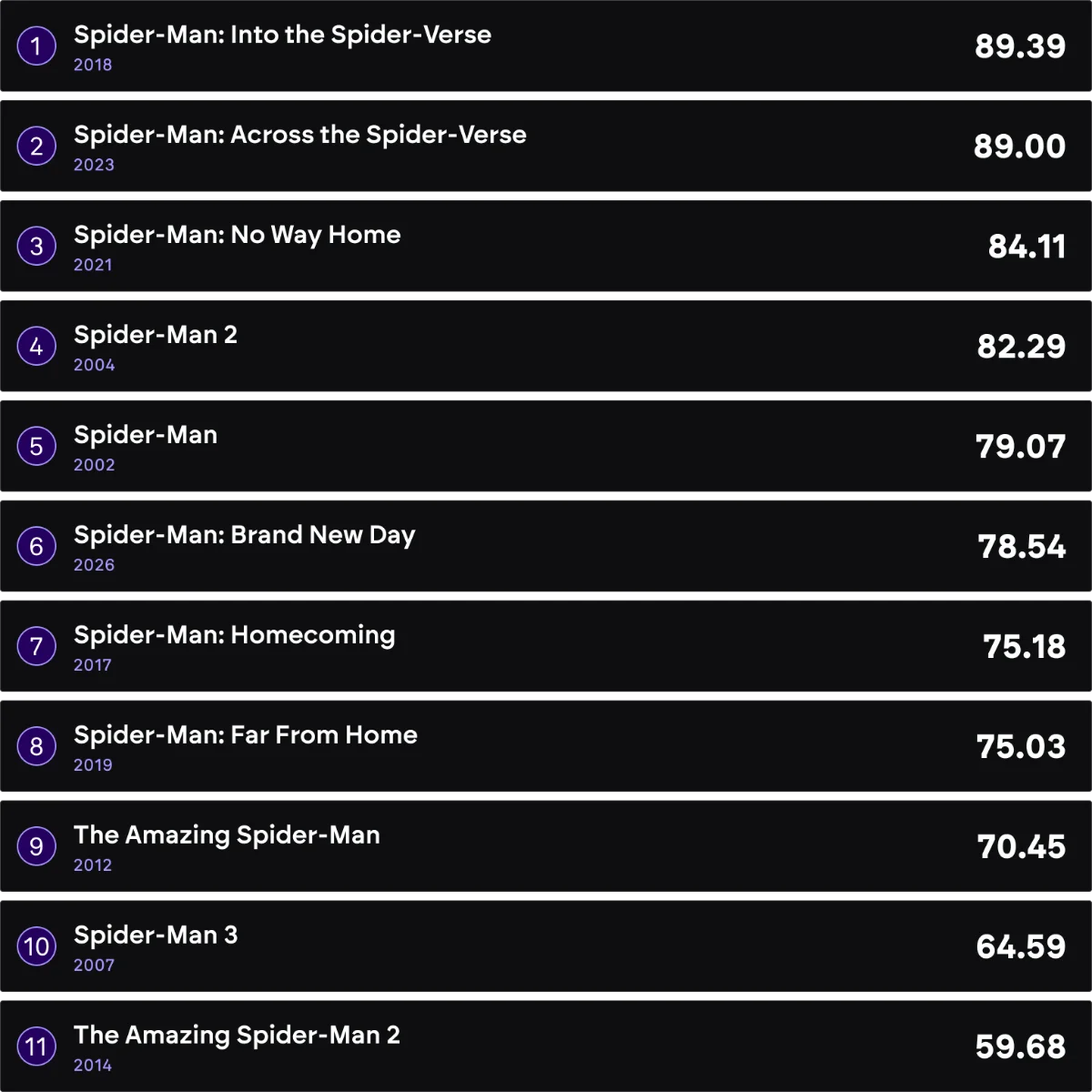
Our Thoughts on Brand New Day
Brand New Day is the type of movie the MCU should've been making for the past 5 years. The sprawling character web involving the Punisher, Hulk, Scorpion, and Jean Grey is really what the later-stage comics have been doing to keep audiences engaged with the characters they care about (and of course sell more copies). As these familiar faces interact, the challenges they present to each other begin to show us how they deal with different personalities. Imagine if they had been properly introducing Mutants piece by piece à la Black Widow in Iron Man 2. Of course, some of this makes it unwieldy; these films really can't be less than two hours anymore because they need to round out more of the characters' interactions (sorry, Hulk). Brand New Day still aptly focuses on the primary hero's new journey, and it's well done enough to continue building faith in the brand of Spider-Man and Marvel Studios.
There's been a lot of murmur that the era of superhero cinema is in its twilight. Perhaps it is, though the metrics really say otherwise. They're still beloved characters that can bring out people in droves, some more than others, sure, but the checks are sure to keep clearing and continuing the cycle for the foreseeable future. There have been a couple of hiccups here and there since 2002, and perhaps sunsetting parts of Fox-era X-Men is simply part of the process. After all, it took two Peter Parkers to eventually find the tone that's been with us over ten years now. And hopefully the large studios continue to learn as much from these successes as from their failures.